
By Rémi Mathieu!
At the end of 2024, I was working as an in-house game designer at IELLO when Samson from This Way contacted me to work on their next big project: “ARCTICA.” It would be a game with a deck of 160 unique cards, and would be a large crowdfunding project. Everything about it piqued my curiosity. I had several projects I was working on, and unfortunately I didn’t have the time to dive into it fully. But when Samson offered me the chance to work full-time on the project (as he would be mostly busy finalizing their other games), I jumped at the opportunity. My life was about to become Arctic for several years.
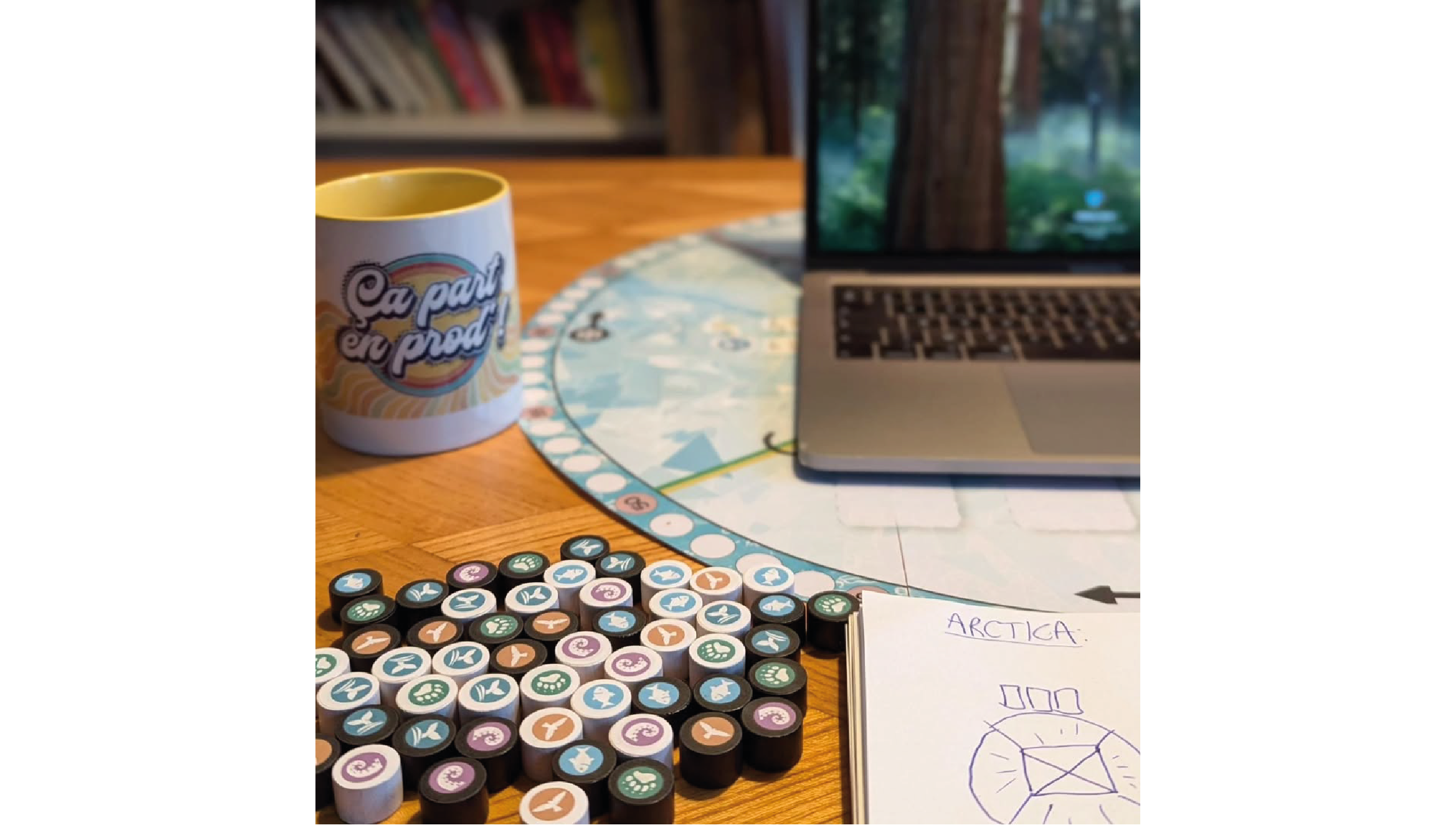
Beginning of Arctica, the animal tokens were there:)
CONSTRAINTS ARE GOOD! 💪
While working at IELLO, I quickly realized that constraints act as a catalyst for creativity. I was often given specific constraints there: “Make a meme game!” “Make an outdoor game out of wood!” And it was precisely these constraints that fueled my creative spirit. It’s difficult, if not impossible, to move forward with a new project without certain parameters.
For ARCTICA, there were several:
- The Theme: the game had to be about the Arctic region — its flora and fauna, and the impact that we humans have on this area.
- Material: Samson wanted wanted interlocking wheels that would act as an automatic resource distributor.
- The Cards: Samson and his mother had already listed and illustrated the 160 animals that would make up the game.
- The Scope: as a future Gamefound project, I wasn’t limited to a small box game with certain components. With This Way specializing in Collector editions, I could “think bigger.”
THE ANCIENT KNOWLEDGE EXPERIMENT 🧭
I currently have several games out, and others in the process of being published. But it was my very first game, “Ancient Knowledge,” that taught me the most about game design. Looking back, I can say that AK was released four years too late: in this game, you only discover the real fun after three or four plays (which is a bad idea nowadays), and the game has a lot of downtime with three or four players (which is also a bad idea nowadays).
But mistakes help you grow, so before thinking about this project, I listed all the things I needed to include or not include in the game design of ARCTICA. A sort of specification:
- Little or no downtime: players needed to feel involved at all times during the game. The dopamine needed to flow continuously around the table.
- A satisfying first play: nowadays, if the first play isn’t perfect, players move on to something else.
- Always move forward: players should never be blocked. This does not mean removing all frustration and tension, it just means that a beginner player should always be able to do something, even if it is not the optimal action.
- Interaction: I didn’t want to make another solitary multiplayer game like AK. It’s not that I don’t like that style, but I wanted to create more interaction between players for ARCTICA.
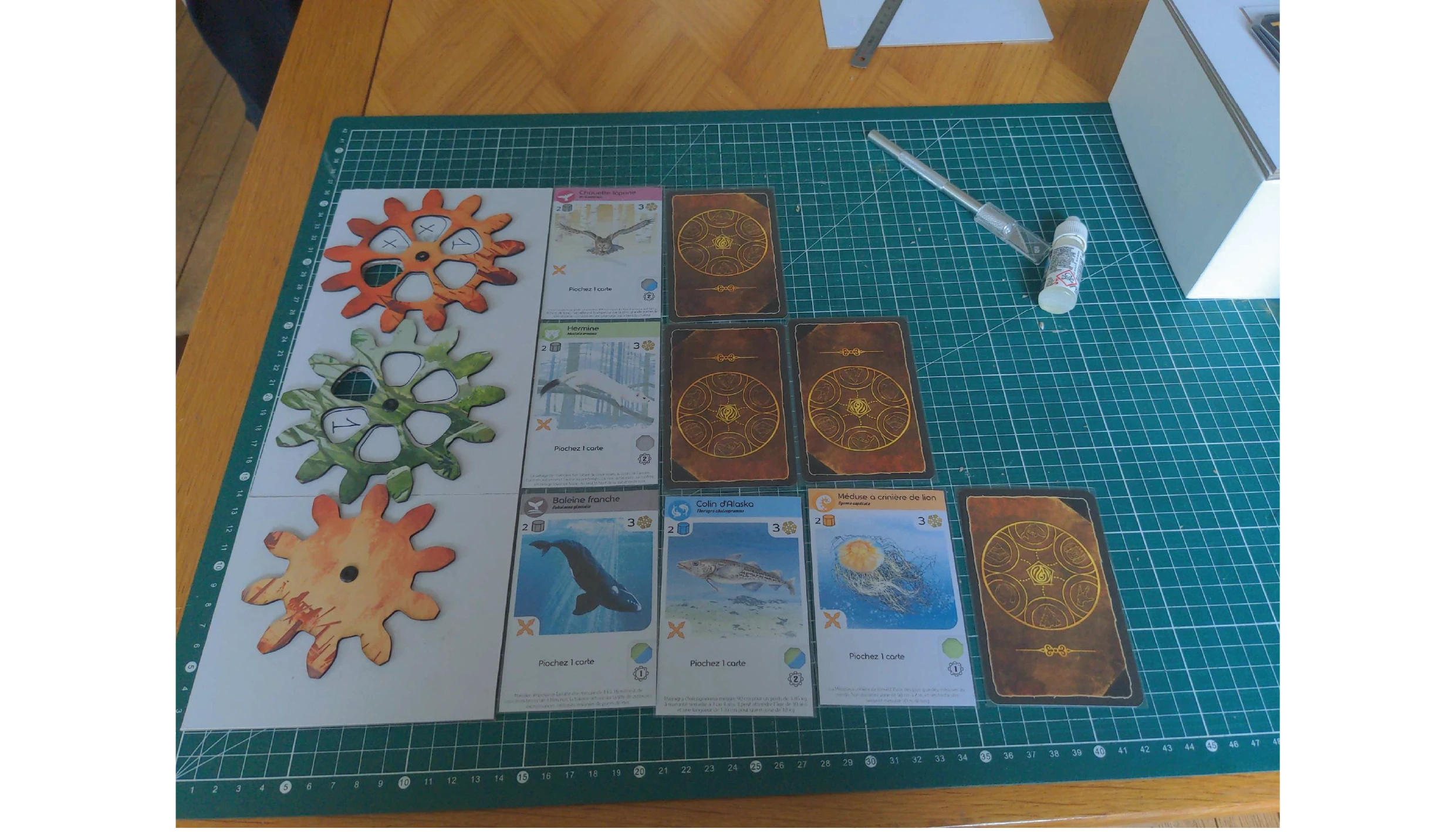
One idea that doesn’t make it: animals in 3 row with sea, land and air.
FIRST STEPS 🐾
With these constraints and specifications firmly in mind, I began my work on ARCTICA. The feeling at the start of each of my projects is always a little bit of ambivalence: on the one hand, there is the excitement of all the possibilities open to me, and on the other, the abysmal emptiness of the blank page. You start the project with very few elements and you never know when the first idea will come to you.
I had previously created a mechanic for the first version of Ancient Knowledge that I loved, but I had to put it aside. I always told myself that I would use it in a later project, and it turned out that ARCTICA was the perfect one for this mechanic.
In this version of Ancient Knowledge, we had the Giza plateau and its three pyramids. On each of them were four different actions. On your turn, you placed the action token on one of the six spaces. You then rotated one of the two pyramids a quarter turn. You performed the two actions designated by the token while all the other players simultaneously performed only one of the two actions.
This led to constant gameplay flow, which was perfect for what we wanted to do with ARCTICA. I now had a mechanic to start thinking about. But that still didn’t answer the question: what do these 12 actions do?
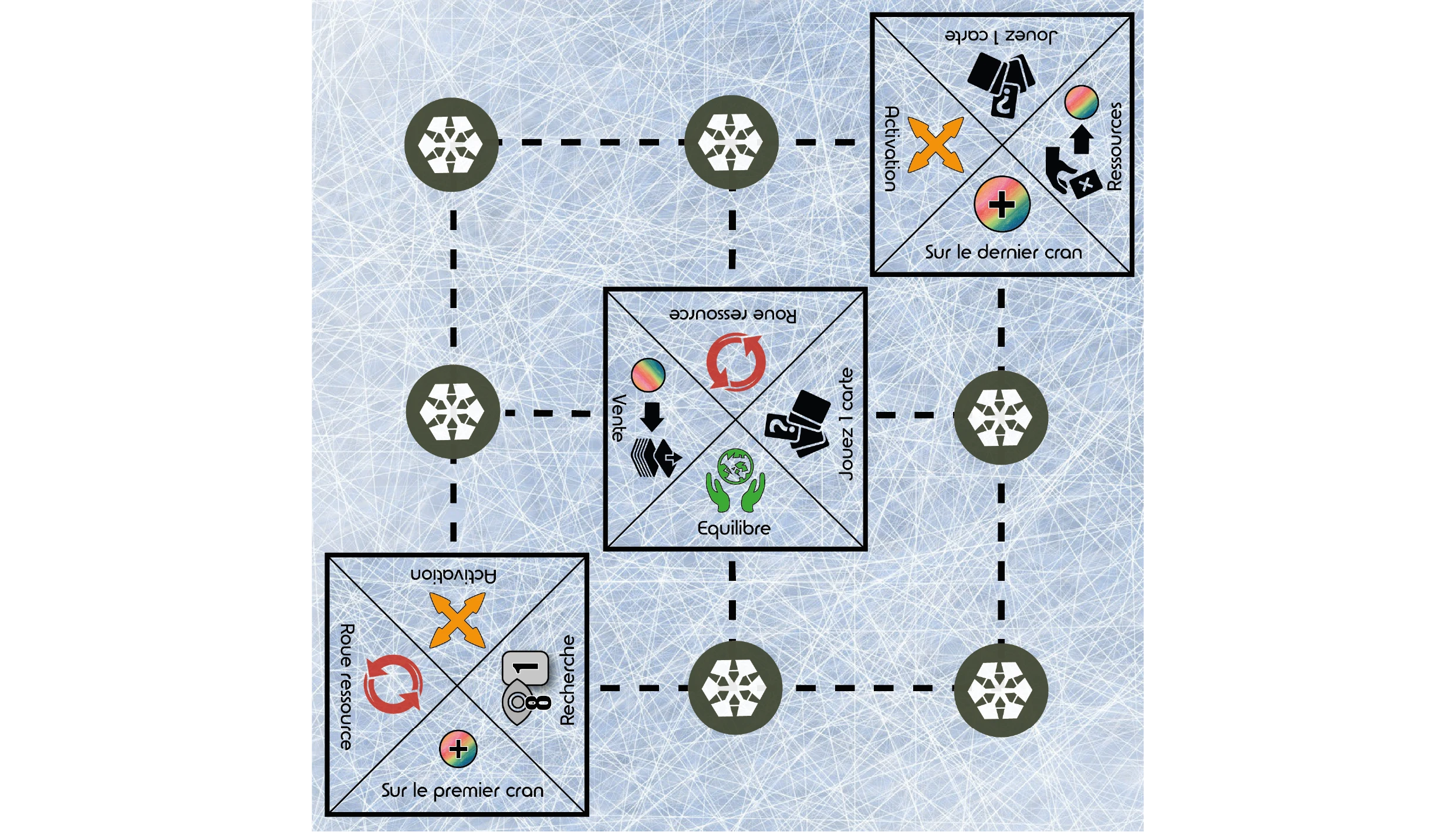
First concept of the action board for Arctica.
THE GENERATION WHEELS ⚙️
Samson immediately told me about his desire to have an automated resource dispenser using wheels. It was a good, innovative idea, even though other games have had similar concepts — but we wanted our experience to feel more personal and satisfying. For ARCTICA, we wanted players to be able to spin a wheel and advance their entire ecosystem by one generation, allowing them to collect their resources directly without having to touch them.
Samson had two wheels in mind: one with a short generation (that would produce more quickly), and a second one with a longer generation. It seemed logical that these resources would be the animals themselves. The cards would allow animal tokens to be reproduced on these wheels. After a certain number of turns, these tokens could be used as resources.
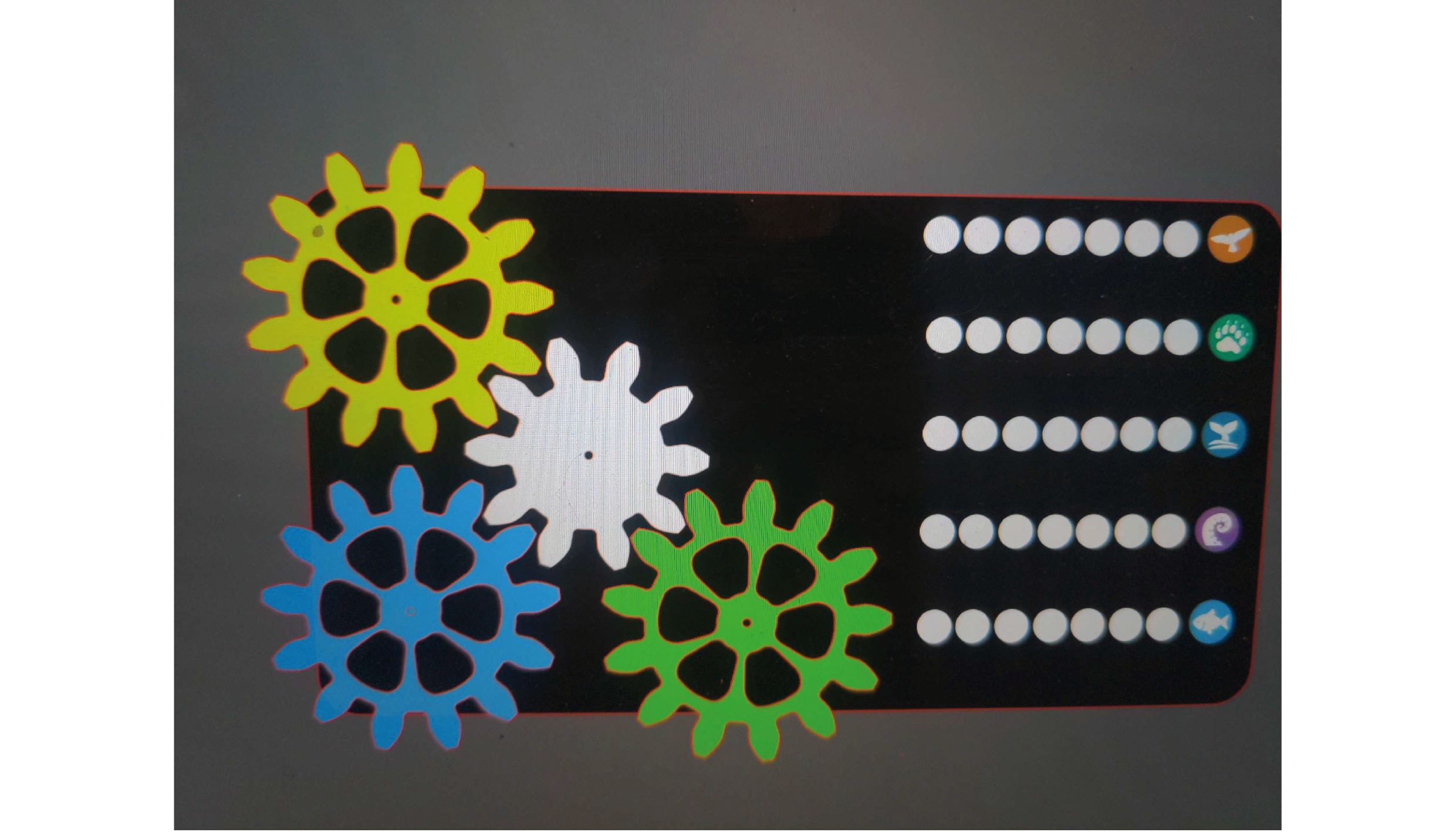 Conceptual idea for the player board.
First test of the player boards, you can hear my happiness 🙂
THE COLUMN BUILDING IDEA 💡
I wanted to create a board game with collectible badges and combos to trigger. I’m a big“Race for the Galaxy” fan for sure — and you can see this inspiration in the final game design: we have to discard cards from our hand to play a card.
When you think about a card game, the first thing you think about is when those cards will take effect. At first, the fauna cards had effects when they were played, when the animal was reproduced, and when its ability was used. As I started tinkering around a bit, I quickly realized that once 4 or 5 cards were played, it was very difficult for the players to keep track of all the possibilities available to them.
And so the idea of column building was born to speed up the game. When you play a new card, you place it on top of the previous one. Only the top card is available and can be activated. The logical next step was that when the card was used, it would go to the back of the pile and the next cards on top would have to be activated for the previous ones to be available again. It was a kind of cycle, which sounded good thematically.
So we would have two columns. One for each wheel: the short generation column and the long generation column.
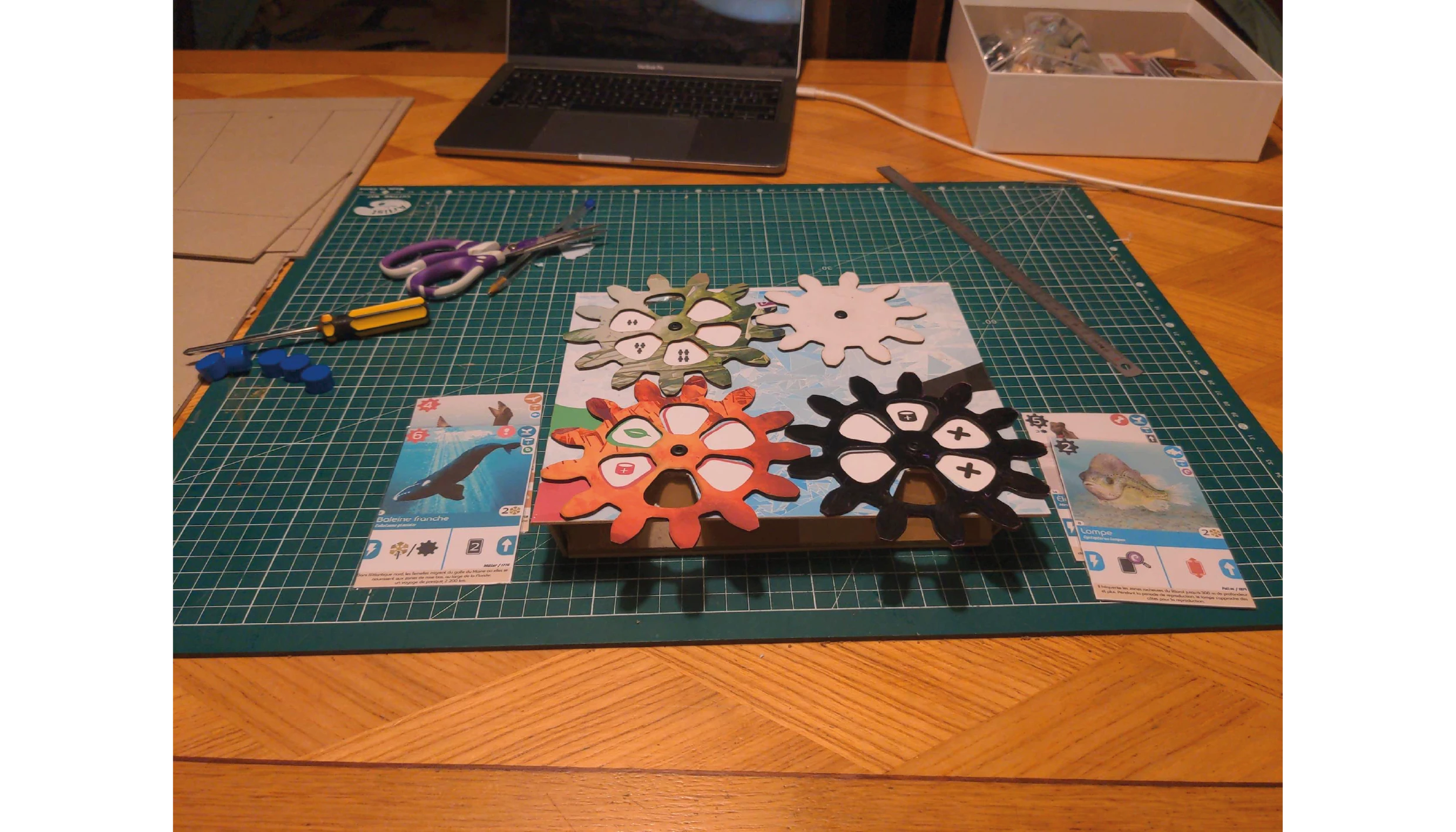
Testable version of column building
TEMPORARY IDEA: MINI-GAMES
We now knew how to produce the animal tokens, but the most difficult question remained: what could players do with their tokens?
I initially had an idea for four mini-games, which would symbolize four themes of the Arctic region: melting ice, species proliferation, human and natural events, and maintaining biodiversity. I started working on four distinct mechanics, and as I write these words, I realize that I was likely influenced at the time by my discovery of the game “Fromage,” which had a wonderful idea of four distinct mini-games that were all logical and simple.
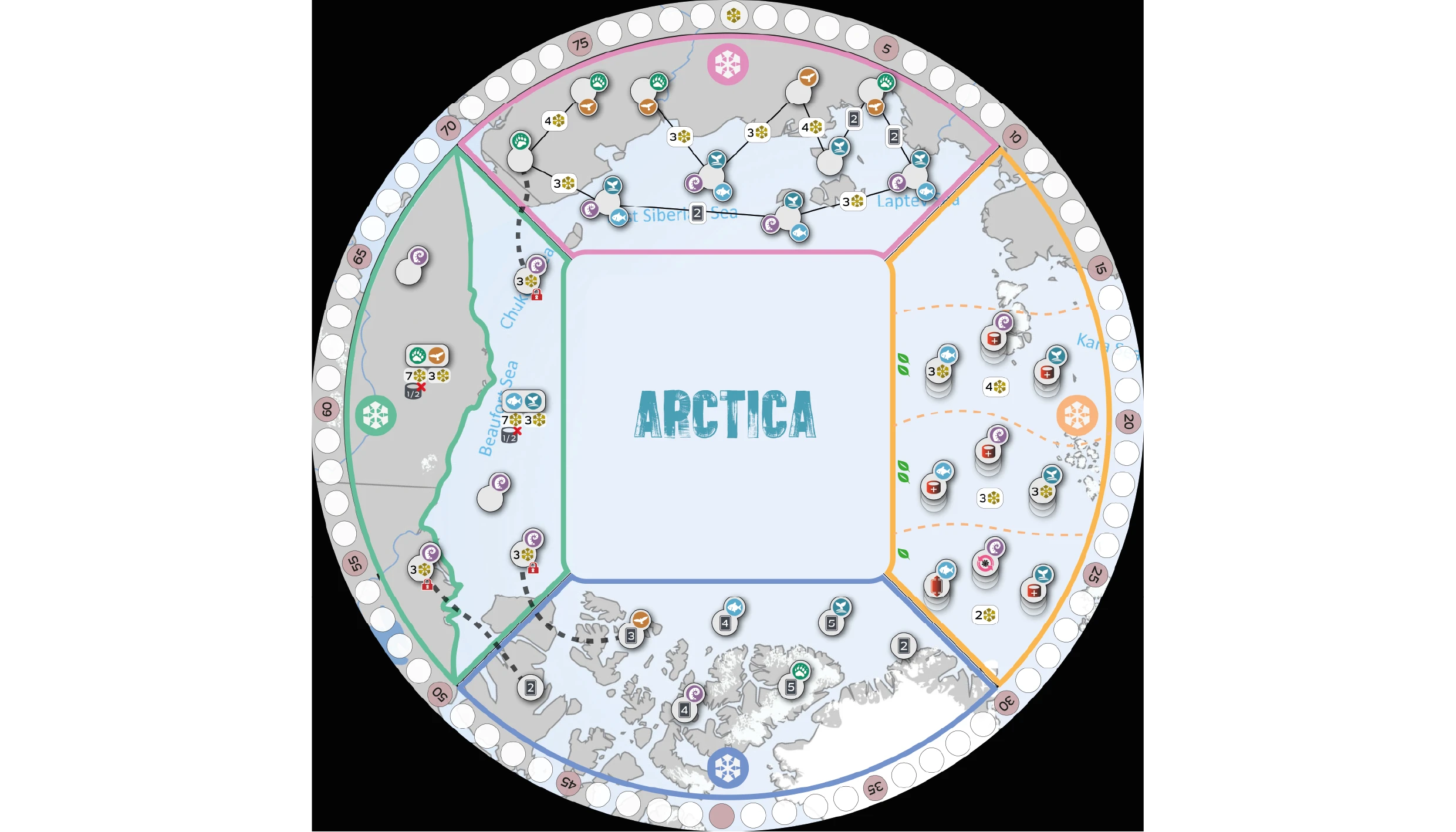
The first iteration of the central board. It looks a bit like Fromage. You can see the first four mini-games: connections in pink, melting ice in yellow, a majority of Air/Sea in green, and a way to draw cards in blue.
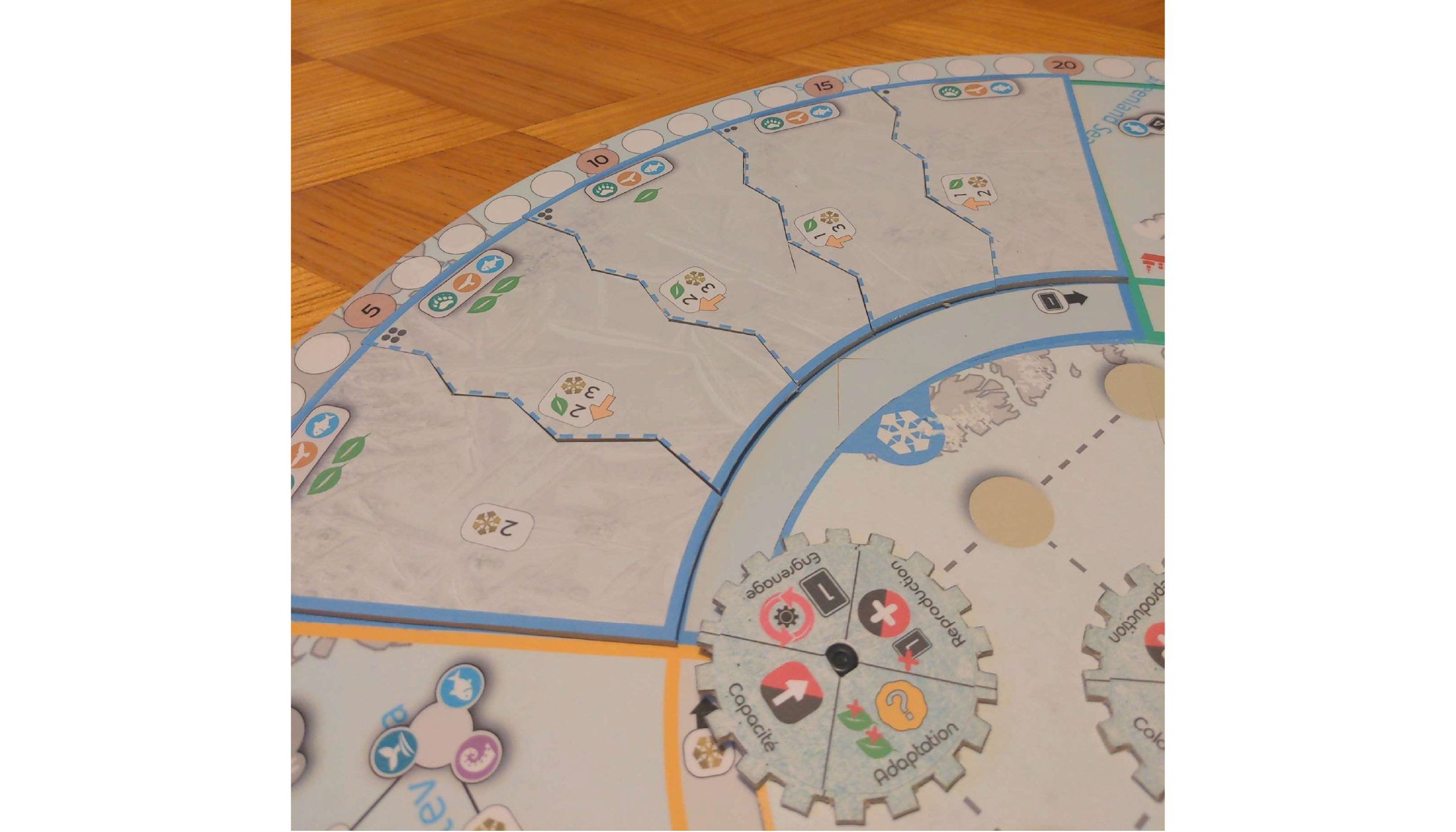
The mini-game “Melting Ice”: the animals had to flee the melting continent.
THE SEARCH FOR INTERACTION 👀
Most games with simultaneous action choices are solitary multiplayer games. Interaction is always indirect — relegated to the background, and sometimes even absent. I really wanted to create tension around the colonization of the central board, and it was clear that this wouldn’t work if all players played simultaneously.
The ARCTICA system revealed that the game worked in two stages: first, you build your engine to produce animal tokens on your wheels, and second, you use these tokens to colonize the board through the Colony action. Since this was the only action that prevented simultaneous play, the solution was obvious: 11 actions would be performed simultaneously except for Colony. This still allowed for almost no downtime, while maintaining interaction between players — and now there was a strategy for how and when the Colony action would be played.
I’ll spare you the long hours of unsuccessful testing and failed iterations. The four mini-game concepts were all kept, but we intertwined them all together: the ice melts in each region, you can make connections in each region, there are majority bonuses in each region.
EVENTS 💨
The idea of events disrupting Arctic flora and fauna was already present at the start of the game design process. The first iteration consisted of cards that added rules and penalties. The tests were inconclusive, but my wife (my favorite playtester) had the brilliant idea that events could be tiles that would be placed directly on the board causing a permanent change to the landscape. An oil spill could now appear on the map and alter the direction of the game…
Since the tiles destroy existing ecosystems, we had to find a way to save our animal tokens to limit the frustration of the players who were potential victims. That’s when the idea of an Arctic Circle came to me. Located to the North, it allows animals to flee to safety, migrating around it to return to safer places on the map. And now one of the 12 main actions would move those animals in this circle, allowing for additional bonuses along the way.
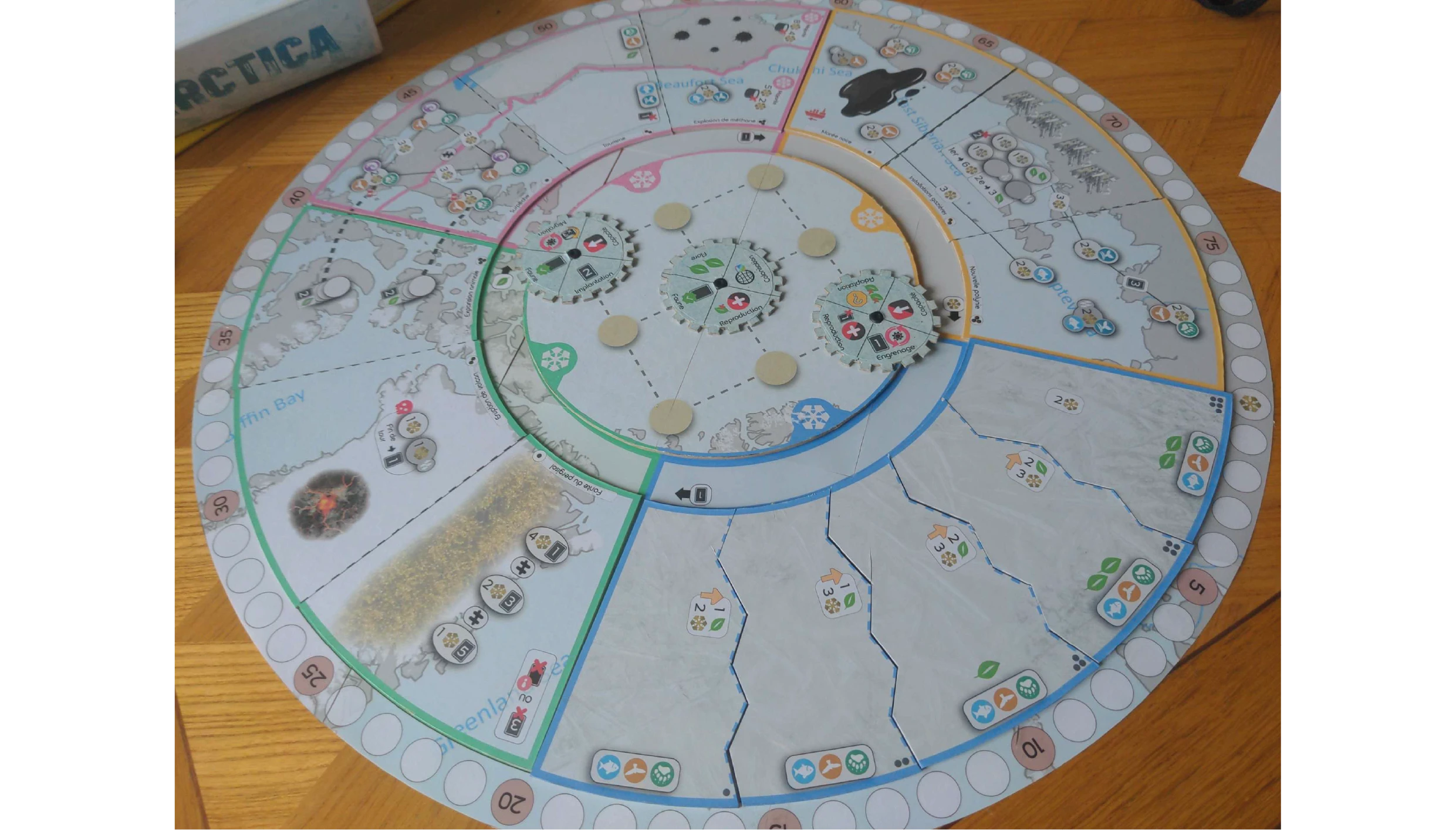
The first nine events and the integration of the Arctic Circle
THE PRESSURE EASES OFF 😅
The timing for ARCTICA was very tight: we had a year and a half to complete it, and I knew from the outset that I had to find a good basis very quickly because an “expert” game requires a huge amount of development time (especially with a large deck of cards). Every day without finding the basic concept was one day less to develop it.
The big crash test took place at the Cannes International Games Festival, where I had organized meetings with many professionals from the board game industry. Despite many areas for improvement, the feedback from them was very positive, which reassured me that we were heading in the right direction. Phew! Having a tight schedule pushed me to do better, but I’m sure my wife was relieved when I started bringing less stress home.
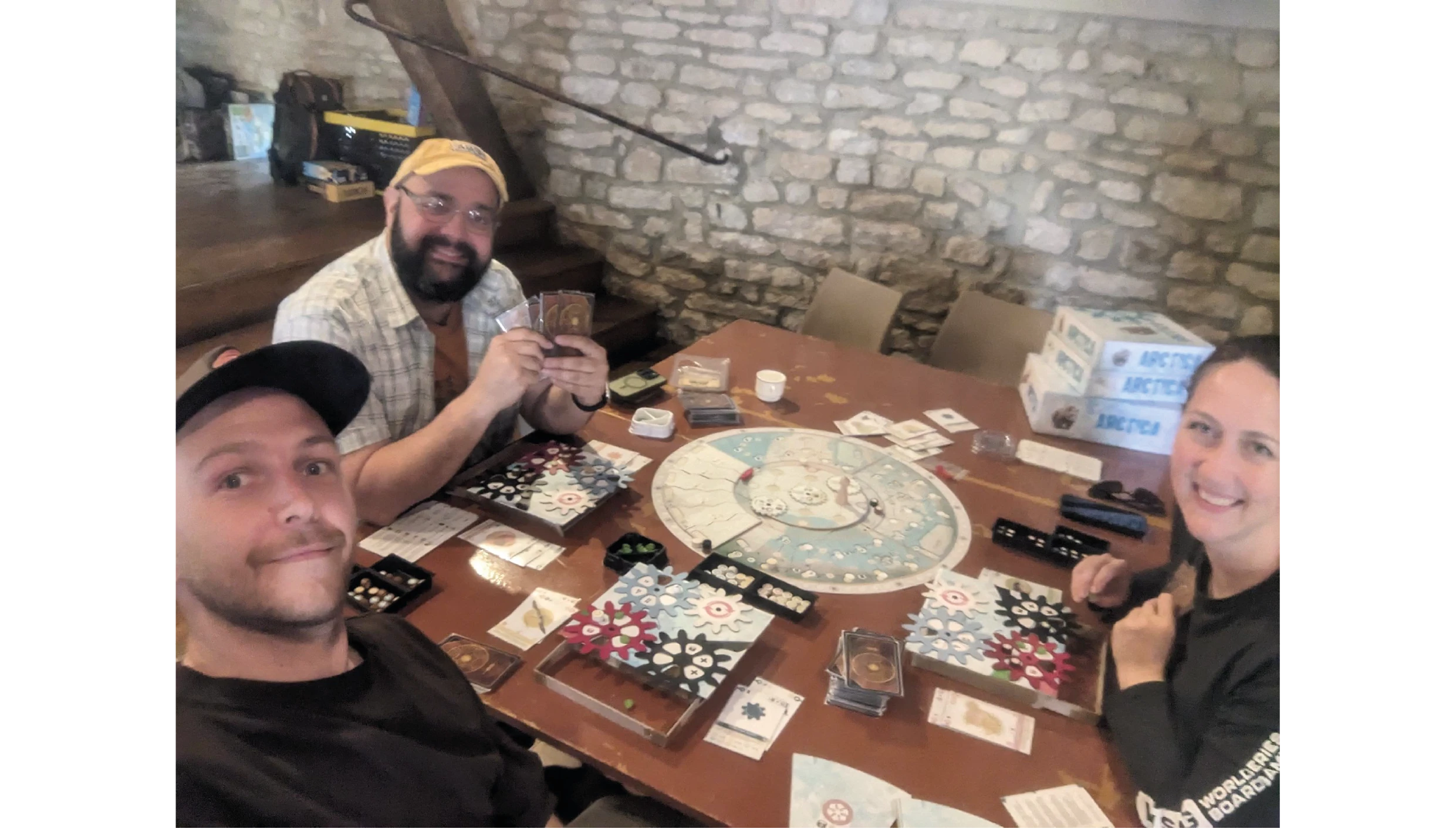
Camilia and Zee playtesting Arctica at “Les ludopathiques” .
FINAL DEVELOPMENT 🤓
The stress was gone, but a long and tedious task was about to begin: the final development of the game. We had to make this solid foundation as perfect as possible. We had to test it, reshape it, push it to its limits, and simplify it. Many changes have been made since Cannes. It was the first time I had worked on a single game full-time, and it really helped with development and speed of progress. But all that will be for a future update…
- Rémi Mathieu, Game designer and Head of development for This Way
